
Key takeaways
- Preventive screenings help detect health issues early, often before symptoms appear.
- Men’s screening needs change based on age, lifestyle, and risk factors.
- Staying up to date on screenings can improve long-term health and quality of life.
- Having a primary care provider and the right coverage can make preventive care easier to access.
Preventive health screenings are one of the most effective ways men can stay healthy. Many serious conditions—like heart disease, diabetes, and certain cancers—can develop without noticeable symptoms. Regular screenings help catch these issues early, when treatment is often more effective and less invasive. While general guidelines exist, the right screening schedule depends on your age, medical history, and personal risk factors.
Getting regular health screenings is an important part of men’s well-being. By identifying problems or potential problems early on, you can make lifestyle changes or start treatment sooner to prevent serious disease.
Preventive healthcare starts with a visit to your primary care provider. From there, you can discuss your personal health, goals, and things you can do to stay healthy—including health screenings.
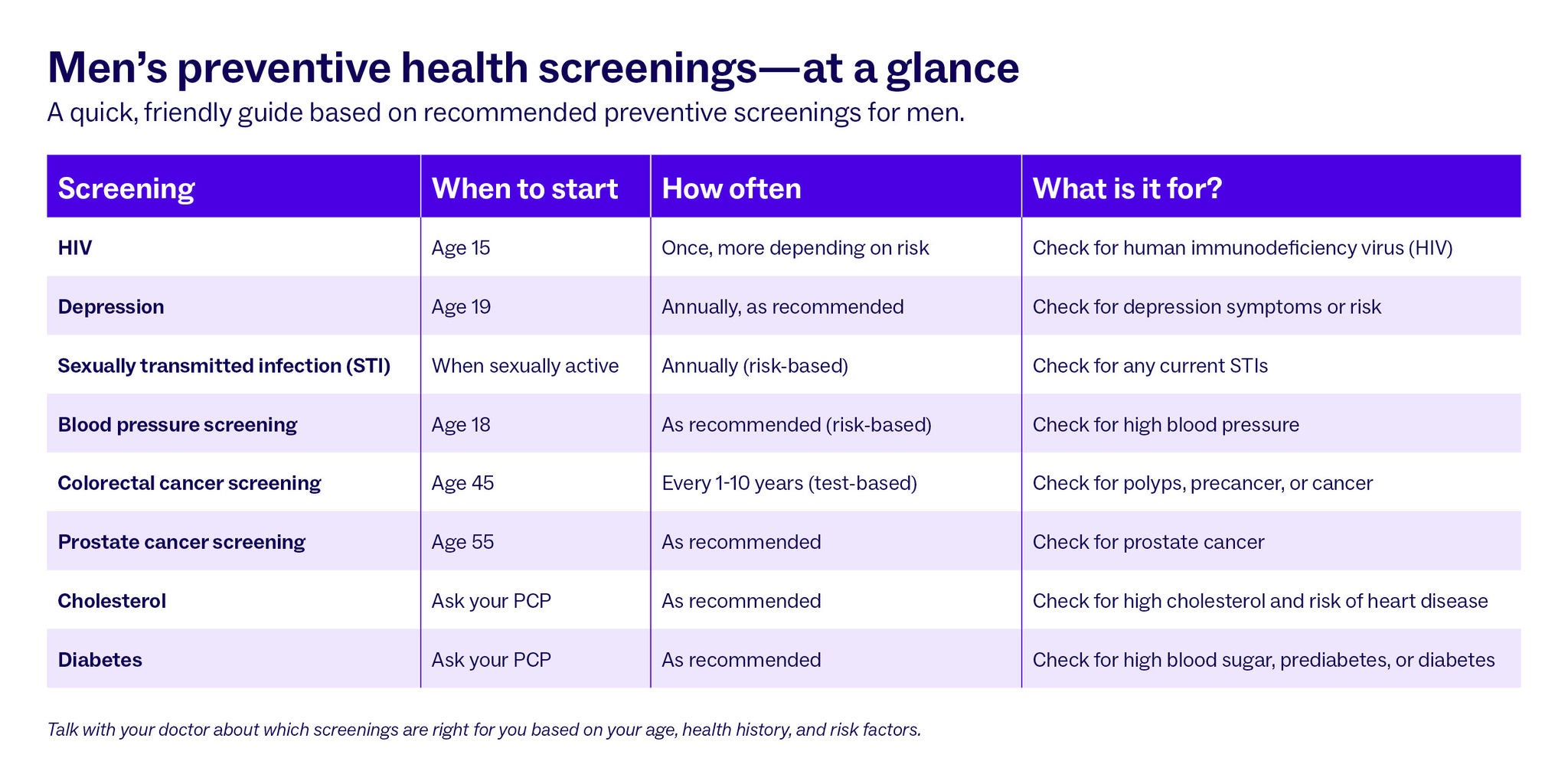
Depending on your age and risk, there are different men’s health screenings you can expect to get throughout your life. Here are eight screenings you may need:
STI screenings
Sexually transmitted infections (STIs) are infections that spread through sexual contact. They can be caused by bacteria, viruses, or parasites and may not cause symptoms right away, according to the Centers for Disease Control.1
Untreated STIs can lead to serious health problems, the U.S. Preventive Services Taskforce (USPSTF) says.2 They recommend screening men for syphilis and other STIs at least once a year if they are sexually active and more frequently if they are at higher risk of infection.
Talk to your doctor about your risk level and how often you should be tested.
HIV screening
Human immunodeficiency virus, or HIV, affects the immune system and, if untreated, can lead to serious complications. According to the USPSTF, about 1.1 million people in the U.S. have HIV. Early detection allows people to start treatment sooner and live longer, healthier lives.
The USPSTF recommends that adolescents and adults ages 15 to 65 get screened for HIV at least once, with additional screening for those at higher risk.3 Research shows HIV diagnoses go up significantly at age 15, making screening an important part of men’s and young men's preventive health.
Testing for HIV is usually done through a simple blood test at your doctor’s office.

Blood pressure screening
High blood pressure, also known as hypertension, affects about 45% of U.S. adults, according to the USPSTF.4 Over time, it can increase your risk for heart failure, heart disease, chronic kidney disease, and stroke.
The USPSTF recommends regular blood pressure screening for men. If you’re under 40 years old without a history of higher blood pressure readings and no risk factors, you can usually go 3-5 years. For men 40 and up, they recommend getting your blood pressure screening once a year.
If you’re concerned about your blood pressure, talk to your doctor. Screening is very simple, but it can make a big difference in your health and future health.
Cholesterol screening
Cholesterol is a waxy substance your body uses to make hormones and digest fatty foods, but having too much can increase your risk for heart disease, according to the CDC.5
Some things can raise your risk of developing high cholesterol, such as eating a diet high in saturated and trans fats, not getting enough exercise, and having a family history of high cholesterol.5
Many people have high cholesterol and don’t know it, so getting screened is important. Your doctor can help determine your risk and how often you should be screened.
Diabetes screening
Type 2 diabetes is a condition where your body doesn’t produce or use insulin like it should. When this happens, your body can’t regulate blood sugar like it did before. Over time, it can lead to heart disease, kidney disease, and vision loss, according to the CDC.6
The USPSTF recommends adults ages 25-70 who have overweight or obesity should be screened for type 2 diabetes. Talk to your healthcare provider about your risk and if or when you should be screened.7
Depression screening
Depression, or major depressive disorder, is one of the most common mental disorders in the U.S., according to MedlinePlus.8 It can affect how you think, feel, and go about your day.
Depression can cause many different symptoms, and they’re often different from person-to-person. Some people sleep more or less than usual, eat more or less than usual, lose interest in their favorite activities, or feel down or irritable.
Sometimes, people don’t even know they have depression until they’re screened for it. That’s why it’s important to find a primary care provider and get regular screenings.

Colorectal cancer screening
Colorectal cancer is the third most common cancer worldwide according to the National Cancer Institute.9 While it’s most common among those age 65 and older, younger adult cases are on the rise.
The USPSTF recommends that adults at average risk begin screening at age 45.10 Adults ages 50-75 should be screened regardless of risk. Test options may include stool-based tests or procedures like a colonoscopy.
These screenings can detect early signs of cancer or even prevent it by identifying and removing precancerous growths. Your doctor can help you choose the right screening method based on your preferences and risk factors.
Prostate cancer screening
Prostate cancer is one of the most common cancers in men, according to MedlinePlus.11 Age, family history, and race can raise your risk of developing it.
There’s no one-size-fits-all approach for prostate cancer screening. The current recommendation for men ages 55-69 is to talk to your healthcare provider.12 Your risk and any possible symptoms you’re experiencing can make a difference in deciding to screen or not.
If you and your provider decide to screen for prostate cancer, you’ll most likely have a blood test called a prostate-specific antigen (PSA) test.
Take charge of your health
The best way to stay on track with your health and preventive screenings is to work with a primary care provider who can guide your care. If you’re due for a screening or aren’t sure where to start, schedule an appointment with your provider to talk through your options.
If you’re a Select Health member, you can find a provider or explore your preventive care benefits on our website to take the next step toward better health.
If you’re looking for a new health insurance plan that supports your efforts to live a healthy life, browse our plans at SelecHealth.org/Plans.
This article is intended for informational purposes only and is not legal or medical advice. Links to other sites are provided as a convenience, but Select Health does not endorse the third-party sites, information, or services.
The content included here is for your information and not a substitute for professional medical advice. It should not be used to diagnose or treat a health problem or disease. Please consult your doctor if you have any questions or concerns. Additionally, this information does not guarantee benefits. To review your benefits, please reference your plan materials or call Member Services at 800-538-5038 weekdays, from 7:00 a.m. to 8:00 p.m., and Saturday, from 9:00 a.m. to 2:00 p.m., closed Sunday. TTY users call 711.
Sources
1. About Sexually Transmitted Infections (STIs), Centers for Disease Control, 2024
2. Syphilis Infection in Nonpregnant Adolescents and Adults: Screening, U.S. Preventive Services Taskforce, 2022
3. Human Immunodeficiency Virus (HIV) Infection: Screening, U.S. Preventive Services Taskforce, 2019
4. Hypertension in Adults: Screening, U.S. Preventive Services Taskforce, 2021
5. About Cholesterol, Centers for Disease Control, 2024
6. Diabetes Basics, Centers for Disease Control, 2026
7. Prediabetes and Type 2 Diabetes: Screening, U.S. Preventive Services Taskforce, 2021
8. Depression, MedlinePlus, 2025
9. Colorectal Cancer Screening (PDQ®)–Patient Version, National Cancer Institute, 2025
10. Colorectal Cancer: Screening, U.S. Preventive Services Taskforce, 2021
11. Prostate Cancer, MedlinePlus, 2024
12. Prostate Cancer: Screening, U.S. Preventive Services Taskforce, 2018
Related Articles