
Key takeaways
- Preventive health screenings help detect diseases early, often before symptoms appear.
- Women’s screening needs evolve with age, risk factors, and personal health history.
- Staying on track with screenings supports long‑term health and peace of mind.
- A trusted doctor and the right health insurance coverage make preventive care more accessible.
Regular health screenings are one of the most effective ways women can stay or become healthy. Many conditions, such as cancer, heart disease, diabetes, and osteoporosis can develop without symptoms for years. Preventive screenings help catch issues early, when treatment is most effective and less invasive. While guidelines provide a general roadmap, the right screening schedule depends on your age, family history, lifestyle, and overall health.
Preventive health screenings for women are some of the most important things you can do for your health and wellbeing. According to a survey conducted by Hologic, 43% of women in the U.S. skipped or delayed recommended health screenings, even when they knew the screening was important.1
Though it can be hard to carve out time in your schedule, and some screenings might seem intimidating, taking responsibility for your health is one of the best things you can do for your future self. Plus, most preventive care screenings and services are covered at no or little cost.
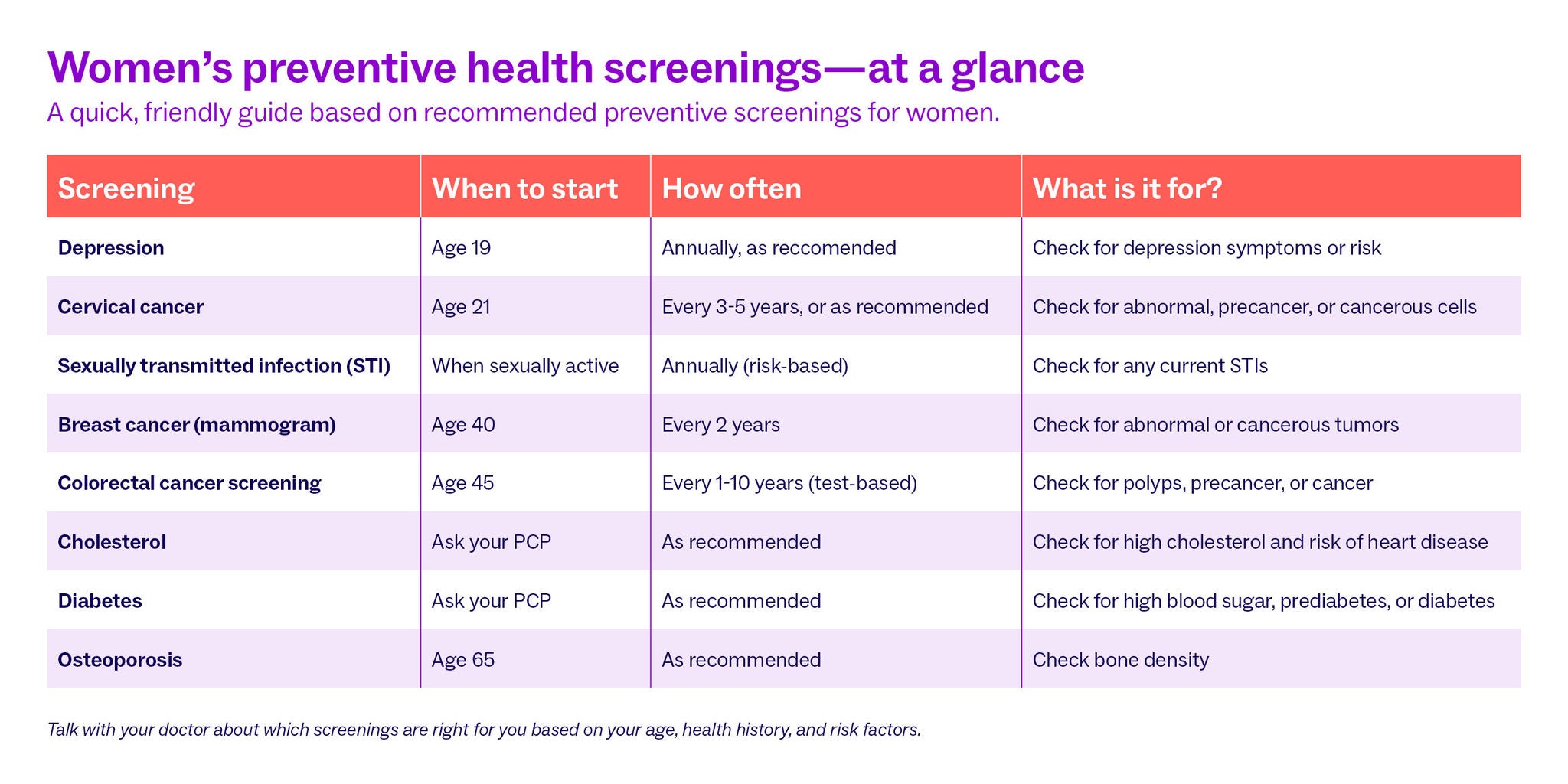
Women will need different health screenings throughout their lives, depending on age and risk factors. Here’s a list of women's healthcare screenings you should talk to your doctor about:
Cervical cancer screening
Cervical cancer screening is a screening test that can identify abnormal or precancerous cells early on. By screening regularly, you can have peace of mind knowing you’re doing what you can to prevent cervical cancer from developing.
What are the cervical cancer screening tests?
There are two main tests providers can use to screen for cervical cancer: a pap smear and an HPV test. A pap smear and HPV test are both performed the same way, they just test for different things. In each test, a medical provider collects cells from the cervix and analyzes them for either abnormalities or HPV.
When should you get cervical cancer screenings?
Starting at 21 years old, women should start getting cervical cancer screenings, according to recommendations from the United States Preventive Services Task Force (USPSTF).2
When you reach 21, you should get a pap smear. After your first test at 21, it’s recommended you get another pap smear every three years until you reach 30 years old.2
WHen you turn 30, you have a couple more options. You can continue to get a pap test every three years, you can get an HPV test every five years, or you can get both tests (done at the same time) every five years.2

STI screenings
Sexually transmitted infections are infections that pass from one person to another through sexual contact. They can be caused by bacteria, viruses, fungus, or parasites and are usually spread through sex. Some STIs can also spread through close skin-to-skin contact, according to the CDC.3
Untreated STIs can cause many health problems for both men and women. For example, women with untreated chlamydia can develop pelvic inflammatory disease. This can lead to the formation of scar tissue that blocks the fallopian tubes, ectopic pregnancy, infertility, and long-term pelvic/abdominal pain, according to the CDC.4
The USPSTF recommends sexually active women 24 years old and younger get annual chlamydia and gonorrhea screenings. Women 25 years or older with an increased risk of infection should also be tested annually.5
If you have more than one or a new sexual partner, talk to your doctor about how often you should be screened.
Breast cancer screening
Though breast cancer can affect anyone with breasts, it’s particularly important to screen women as they age. Screenings have been found to reduce deaths from breast cancer, according to the USPSTF.6
Getting routine mammograms can help identify breast cancer at earlier stages before it causes symptoms. A mammogram is a series of x-ray images of the breasts that can show tumors or unusual changes, the USPSTF explains.7
How often should you get a mammogram?
Starting at 40 years old, women should get a mammogram every two years, according to USPSTF guidelines.7 If your doctor determines you have an increased risk of breast cancer based on your health and family history, you may need to start screening early and/or more often.
Colorectal cancer screening
Screening for colorectal cancer is becoming increasingly important. According to the USPSTF, colorectal cancer is the second leading cause of death from cancer in the U.S.8 While the majority of people who develop it are 65 or older, younger age groups are seeing increasing cases each year.8
Current guidelines from the USPSTF recommend those without symptoms and have an average risk begin screening at 45 years old.9 In most cases, colorectal cancer screening is done either with a colonoscopy or with a stool test.
A colonoscopy is a procedure where your doctor uses a thin, tube-like camera to look inside your colon and rectum for any polyps or abnormal growths.
Different stool tests can test for different signs of abnormalities, such as blood in the stool or DNA changes. This usually involves sending a sample of your stool to a lab that will check for abnormalities under a microscope.
Depending on your risk, your doctor may recommend one screening test over another other.
How often should you get a colorectal cancer screening?
How often you should get screened for colorectal cancer depends on the test you choose.
- The FIT test, a stool test, needs to be repeated every year.
- FITdna or Cologuard, also stool tests, need to be repeated every 1-3 years.
- Colonoscopies need to be repeated every 10 years.9
Colorectal cancer screening guidelines are for those with average risk of developing colorectal cancer. Your doctor may recommend a different frequency or test depending on your health, family history, and other risk factors.

Depression screening
Based on a survey conducted by Gallup, an estimated 47.8 million people in the U.S. experienced depression in 2025.10 While it’s not something that a blood test can show, it is a real health concern. Symptoms can include feeling sad often, not wanting to do things you used to enjoy, feeling irritable or restless, sleep problems, and more, according to the CDC.11
Sometimes when you’re in the thick of it, you may not even realize you have symptoms at all. That’s why a regular depression screening from a mental health professional or PCP is important.
To screen for depression, your provider will ask you to fill out a questionnaire that asks you about your mood, how well you’re sleeping, and what your appetite is like.
Cholesterol screening
Cholesterol is a waxy, fat-like substance that your liver makes—and it’s actually good for your health, according to the CDC.12 But your body makes all of the cholesterol you need, so you have to be mindful about the foods you eat.
High cholesterol can cause health problems such as heart disease and stroke, so screenings are an important part of preventive health.
A simple blood test can measure your cholesterol levels, so talk to your doctor about getting screened.
Diabetes screening
Diabetes is a common, yet often preventable, disease in the United States. According to a report released by the CDC, it’s estimated that more than 40 million people had diagnosed or undiagnosed diabetes in the U.S. in 2023.13
Diabetes is a chronic condition that affects how your body turns food into energy. When the insulin in your body stops becoming effective, or your body stops making enough, too much sugar stays in your bloodstream. This can cause many health problems down the road, such as heart disease, vision loss, and kidney disease, the CDC reports.14
Testing for prediabetes or diabetes is done through a simple blood test. Talk to your doctor about your risk and getting screened.

Osteoporosis screening
As women age, the risk of developing osteoporosis, a bone disease, increases. While anyone can develop it, women are at a higher risk, according to MedlinePlus.15
People who have osteoporosis have weaker bones that are more likely to break. Because bones are made of living tissue, the body has to break down old bone and replace it with new bone. If your body breaks bone down more than it replaces with new bone, osteoporosis develops.
Many people don’t have any symptoms and only find out they have osteoporosis when a bone breaks, making screening an important part of preventive health. Most providers will order a DXA scan, which is a painless x-ray that measures bone density.
The USPSTF recommends screenings for women 65 years and older.16 Women who are under 65 years and postmenopausal with at least one risk factor should also be screened. If you’re not sure if you have a risk factor that would make you eligible for early screening, talk to your doctor.
Live your healthiest life possible
Daily lifestyle choices, such as eating healthy and getting enough sleep and exercise, can do wonders for your health. But nobody is immune from developing disease. Live your healthiest life possible by getting your recommended screenings and meeting with your doctor regularly to determine your risk. Select Health members can find a doctor on our website or by calling Member Advocates at 800-515-2220 (toll-free).
Select Health values our members and knows the importance of preventing disease and identifying it early. If you need a health plan that supports your wellbeing, check out our health insurance plans.
Frequently asked questions about women’s health screenings
It depends. If your doctor orders bloodwork to diagnose a disease or screen for a disease, your insurance provider may cover it. Call your insurance company to verify your coverage.
The USPSTF recommends women get their first mammogram starting at age 40. If you have a very high risk of breast cancer, you might need screening earlier.7 Talk to your doctor if you’re concerned about your risk.
If you’re 40 years old, you don’t need a doctor’s order for a mammogram. Usually your local hospitals or health clinics have breast cancer screening locations. Select Health members can log into their member account to find a location nearby.
Yes, most of the time. Mammograms are usually covered under the Affordable Care Act for women 40-74 years old every two years.17 Check with your insurance provider before scheduling to learn if you’re covered.
This article is intended for informational purposes only and is not legal or medical advice. Links to other sites are provided as a convenience, but Select Health does not endorse the third-party sites, information, or services.
The content included here is for your information and not a substitute for professional medical advice. It should not be used to diagnose or treat a health problem or disease. Please consult your doctor if you have any questions or concerns. Additionally, this information does not guarantee benefits. To review your benefits, please reference your plan materials or call Member Services at 800-538-5038 weekdays, from 7:00 a.m. to 8:00 p.m., and Saturday, from 9:00 a.m. to 2:00 p.m., closed Sunday. TTY users call 711.
Sources
1. Survey reveals American women are not getting vital health screenings, Hologic, 2024
2. Cervical Cancer Screening, National Cancer Institute, 2025
3. About Sexually Transmitted Infections (STIs), Centers for Disease Control, 2024
4. About Chlamydia, Centers for Disease Control, 2025
5. Chlamydia and Gonorrhea: Screening, United States Preventive Services Task Force, 2021
6. Breast Cancer Screening, National Cancer Institute, 2025
7. Mammograms, National Cancer Institute, 2025
8. Colorectal Cancer Screening (PDQ®)–Patient Version, National Cancer Institute, 2025
9. Colorectal Cancer: Screening, United States Preventive Services Task Force, 2021
10. U.S. Depression Rate Remains Historically High, Gallup, 2025
11. Mental Health Conditions: Depression and Anxiety, Centers for Disease Control, 2023
12. About Cholesterol, Centers for Disease Control, 2024
13. National Diabetes Statistics Report, Centers for Disease Control, 2026
14. Diabetes Basics,Centers for Disease Control, 2026
15. Osteoporosis, MedlinePlus, 2025
16. Osteoporosis to Prevent Fractures: Screening, United States Preventive Services Task Force, 2025
17. Preventive care benefits for women, HealthCare.gov
Related Articles